
Slide sheets are one of the simplest pieces of moving and handling equipment in a care setting. They’re light, cheap and fold into a pocket. They’re also one of the most commonly misused. Used well, they let carers reposition someone in bed with far less effort and far less friction on the person’s skin. Used badly, they can lead to strained backs, skin damage and falls.
Here’s a practical look at using slide sheets safely, and the mistakes we see most often.
What slide sheets are for
Slide sheets reduce friction between the person and the surface they’re lying or sitting on. That makes it easier to move someone up the bed, turn them onto their side, or adjust their position, without lifting their weight. The aim is to slide, not lift.
They’re usually used for repositioning in bed, but some types are designed for other tasks, such as helping with lateral transfers. Always use the sheet for the task it’s intended for, and follow the person’s moving and handling plan.
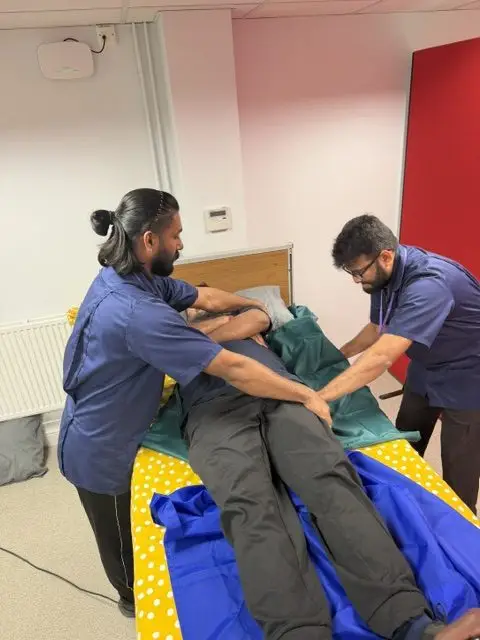
Before you start
- Check the plan. The person’s moving and handling risk assessment should say which equipment to use and how many carers are needed.
- Check the sheet. Look for tears, worn areas or damaged handles, and make sure it’s clean and the right size.
- Set the bed height. Raise a profiling bed to roughly waist height for the carers, and put the brakes on.
- Explain what’s happening. Tell the person what you’re going to do and encourage them to help if they can.
Common mistakes
- Pulling with a bent back. Carers should keep a wide, stable stance and transfer their weight through their legs, rather than reaching and tugging.
- Gripping the person instead of the sheet. Hold the slide sheet, not the person’s arms, clothing or the bottom sheet.
- One carer doing a two-carer job. If the plan says two, it means two, even when the shift is busy.
- Leaving the sheet in place. Unless the person’s plan says otherwise, slide sheets are generally removed once the move is finished. Left under someone, a slippery sheet can make them slide down the bed or even off it.
- Removing it the wrong way. Pull the sheet out gently from underneath, folding it back on itself, rather than yanking it, which can drag on the skin.
Why hands-on training makes the difference
Slide sheet technique looks simple on paper, but small details make a big difference: where you stand, how you hold the sheet, how you coordinate with your colleague. These are much easier to learn by doing than by watching.
In our sessions, staff practise repositioning on a profiling bed using our own slide sheets and equipment, with feedback as they go. You can find out more about how our sessions run on our homepage, or read about the moving and handling mistakes we see most often in care settings.
Matt was really knowledgeable and taught me loads on a subject I have done many times before.
Hayley Pinchbeck, Google review
The law in brief
Across Great Britain, the Manual Handling Operations Regulations 1992 require employers to avoid hazardous manual handling so far as is reasonably practicable, assess what can’t be avoided and reduce the risk. Northern Ireland has its own equivalent regulations. The HSE’s guidance on moving and handling in health and social care is a good place to start.
If you’d like your team to practise slide sheet techniques with proper feedback, get in touch and we’ll arrange training at your service.
Keep your team’s moving & handling skills sharp between sessions
Ready-to-teach refresher packs and observation checklists from our sister company Care Ready Solutions. Editable PowerPoint slides, trainer notes, learner workbooks and certificates, ready to download.
 Moving and Assisting People Training Pack
 Manual Handling of Loads Training Course
 Wheelchair Safety Awareness Training Course
 Manual Handling Observation Checklist


