
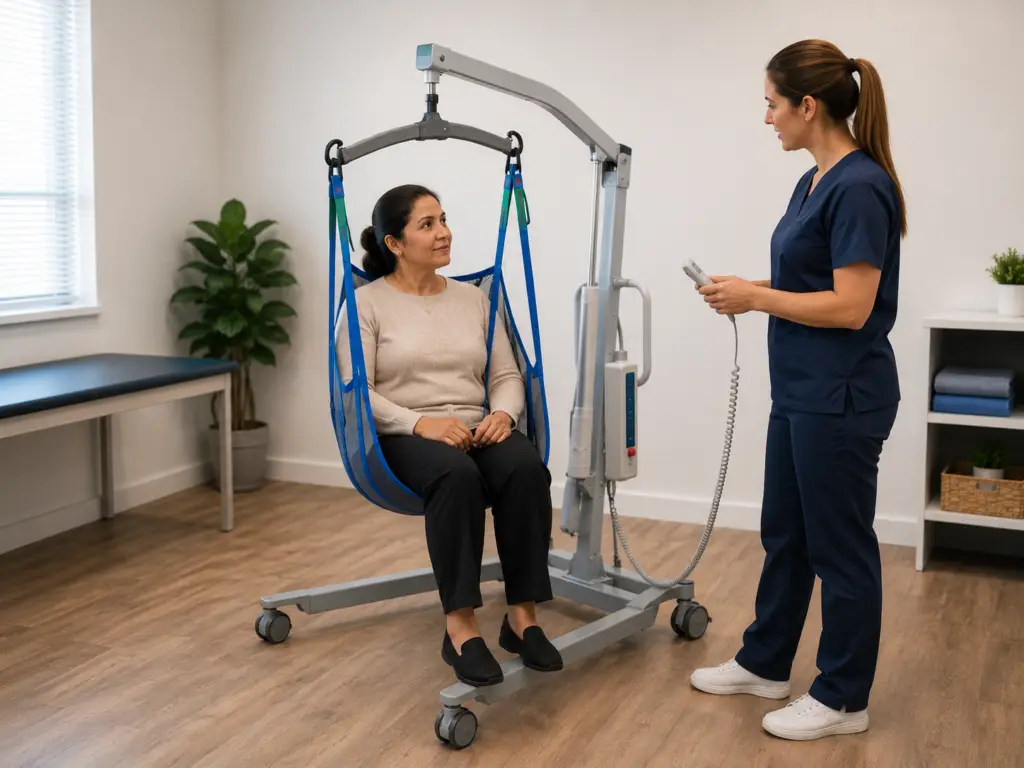
Manual handling mistakes are rarely the big, dramatic stuff. Ask any moving and handling trainer what winds them up most, and it’s the small habits that creep in over time — the shortcuts that feel harmless right up until they aren’t. Here are the ones that show up again and again in care settings, along with what to do instead.
Twisting Instead of Turning
This is the classic. You’re helping someone reposition, your feet stay planted, and you rotate your spine instead of moving your feet. It feels quicker in the moment. It’s also one of the most common causes of lower back injury in care work.
The fix is almost embarrassingly simple: move your feet. Turn your whole body toward the direction you’re going rather than twisting from the waist. It takes maybe two extra seconds and it protects your spine far better than any amount of core strength.
Lifting From the Back, Not the Legs
Everyone’s heard “bend your knees, not your back.” Fewer people actually do it under pressure, especially when they’re tired at the end of a long shift or trying to catch someone who’s started to slip.
The trouble is that by the time you’re catching a fall, good technique has usually already gone out the window. That’s why prevention matters more than reaction — spotting the early signs someone’s unsteady and adjusting your position before the moment of crisis, rather than relying on perfect form in an emergency.
Working Alone When the Care Plan Says two
This one happens for understandable reasons: someone’s on a break, the shift’s short-staffed, and the resident “usually manages fine” with one person anyway. But care plans specify two-person assists because someone assessed the risk and decided it wasn’t safe otherwise. Downgrading that on a busy day isn’t a small judgement call — it’s overriding a documented assessment based on convenience rather than evidence.
If staffing genuinely can’t support the plan, that’s a conversation for a manager, not something to quietly work around shift after shift.
Rushing the Setup
A rushed handling task usually goes wrong before the actual move even starts. Brakes not checked on the bed or wheelchair. A sling put on without checking it’s the right size or attached correctly. The path to the chair not cleared of clutter.
None of these take long to check properly, but they’re the first things skipped when everyone’s under time pressure. A thirty-second setup check is far cheaper than a fall, an injury, or a resident left frightened by a move that didn’t go smoothly.
Ignoring Pain Signals — Your Own or Theirs
Some carers push through their own discomfort because stopping mid-shift feels disruptive. Others miss or override signs that the person they’re moving is in pain, because the move “needs” to happen regardless — getting someone to the bathroom, repositioning to prevent pressure sores, and so on.
Both of these need the same response: stop, reassess, and adjust rather than push on. Pain is information. Ignoring it doesn’t make the underlying problem go away; it just delays the point where it becomes unavoidable.
Treating Equipment as a Last Resort
Hoists, slide sheets, transfer boards — these get treated in some workplaces as things you reach for only when a manual approach has already failed. That mindset is backwards. Equipment isn’t a sign that handling has gone wrong; it’s there to stop it going wrong in the first place. If a piece of equipment is available and appropriate, using it isn’t overcautious; it’s the actual standard.
Letting Training Go Stale
Handling technique is a physical skill, and physical skills fade if they’re not practised or refreshed. A certificate from eighteen months ago doesn’t mean the habits picked up on day one are still intact. Regular refreshers, and honest observation of how staff are actually moving day to day, catch the small drifts before they become ingrained bad habits.
The Common Thread
Almost every mistake on this list comes down to the same root cause: pressure to move faster than the situation safely allows. Fixing that isn’t really about individual willpower — it’s about a workplace culture that gives people the time, staffing, and equipment to do it properly, and doesn’t quietly penalise them for taking the extra few seconds it actually needs.
These patterns match what HSE guidance on manual handling identifies as the main risk factors, and they’re exactly what we work through on our moving and handling training days. If you’d like to talk through what your team needs, get in touch and we’ll take it from there.




